The human-AI trade-off —
and why cognitive atrophy threatens your target’s valuation
AI promises to compress labor costs and supercharge human output. But this leverage comes with a silent operational tax: the erosion of critical thinking, the collapse of junior talent pipelines, and a workforce unable to operate without a digital crutch.
Start here: The plain-language definition
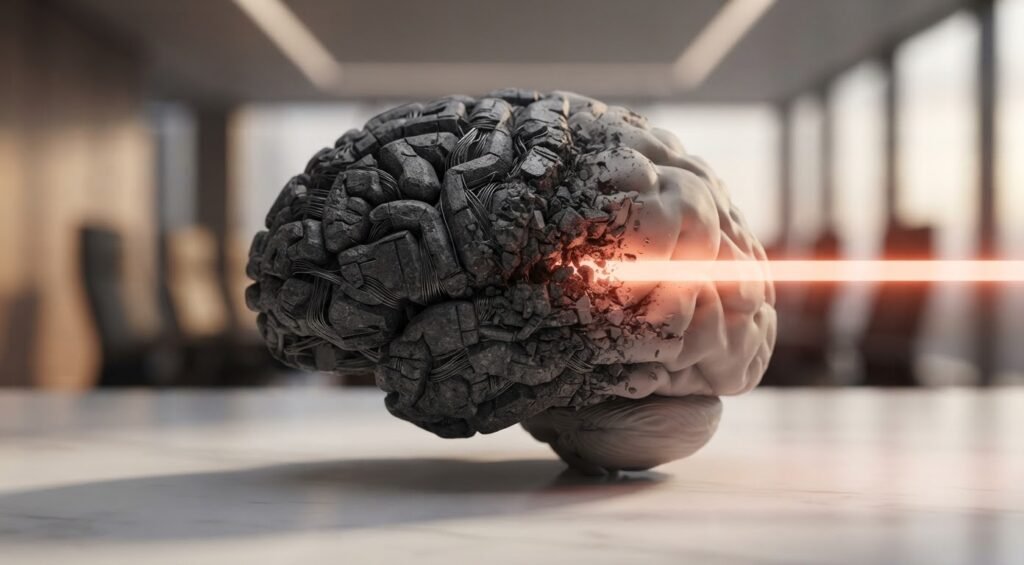
The human-AI trade-off is the exchange of deep, baseline human expertise for immediate operational speed and volume. In an AI-driven workforce, employees transition from being *creators* of work to *editors* of machine-generated output. While this shift slashes the hours required to draft code, write reports, or analyze data, it quietly decouples the workforce from the fundamental skills required to do the job.
Think of this shift like replacing your garage’s skilled mechanics with entry-level operators using diagnostic tablets. The operators can spot and fix common engine faults in seconds using the tablet’s step-by-step instructions (the gain). But if the tablet’s software glitche, or if the engine has a rare, complex issue not in the database, no one in the garage actually understands thermodynamics well enough to diagnose the machine by hand (the quiet loss). Without strict guidance and continuous training, your workforce’s core problem-solving capacity degrades.
“When you automate human cognition with AI, you trade long-term capability for immediate capacity. If your target’s workforce relies on AI models to do their thinking, you aren’t buying a highly leverageable enterprise—you are buying an organization that will freeze the moment the AI makes a mistake.”
Three human-capital layers impacted by the AI trade-off
During due diligence, look closely at how the target's team is evolving. To assess whether their AI-driven productivity gains are sustainable, map their workforce into these three risk layers:
Four human-capital risks to audit in Tech DD
A target's financial model may show impressive headcount efficiency. Use these four checkpoints during due diligence to verify if that efficiency has compromised the company's talent foundation.
Cognitive Atrophy
When staff stop writing, calculating, or coding from scratch, their fundamental skills decay. If the AI tool suffers an outage, pricing hike, or model drift, the team will struggle to perform basic business functions manually, leading to operational paralysis.
The Junior-Senior Talent Gap
If junior work is entirely automated, the company cannot develop senior talent internally. Post-close, you will face high recruitment costs as you are forced to buy expensive, external senior talent to replace aging leadership, erasing your projected labor savings.
The Complacency Blindspot
Because AI outputs look polished and professional, busy employees often accept them without thorough review. This "automation bias" introduces silent, structural bugs, legal liabilities, or factual errors into customer-facing deliverables.
Prompter Dependency Lock-In
If your team's productivity depends entirely on custom-built, undocumented prompts mapped to a specific AI provider (like OpenAI), you face significant platform risk. You cannot easily switch vendors or negotiate pricing without disrupting daily operations.
How the human-AI trade-off alters your financial model
AI-driven labor compression can quickly boost EBITDA margins before a transaction. However, if this efficiency is achieved by stripping out senior oversight and allowing junior staff to run wild with unmonitored AI tools, you are taking on massive post-close operational risk. The short-term savings on headcount are often wiped out by the long-term cost of fixing broken software, correcting compliance errors, and resolving customer churn.
When modeling your post-acquisition expenses, do not assume that current labor costs will remain flat. If the target has hollowed out its senior engineering or product management tiers to hit short-term profit goals, you must budget for a post-close “talent infusion.” Expect to invest in senior systems architects and quality assurance leads to stabilize the automated workflows and protect your exit multiple.
The single signal that proves mature AI human capital governance
In our due diligence work at idbokx, the most reliable indicator of a de-risked, AI-leveraged workforce is a structured AI Upskilling & Red-Teaming Program.
We check if the target has formal, written training modules that teach employees how to audit and challenge AI outputs, rather than just write prompts. An elite team runs regular “cognitive fire drills,” intentionally introducing errors into AI tools to verify if their staff can catch and correct them. This practice ensures that the human layer remains active, skeptical, and fully capable of driving the business forward without technological training wheels.
Buying an asset claiming massive AI-driven headcount savings?
Our Human Capital & AI Risk Framework maps employee dependency on AI tools, tests the cognitive resilience of the engineering team, and quantifies the post-close cost of talent decay—ensuring your operational margins are built on solid ground.